Load-Bearing versus Secondary Locks
The multi-lock trap model (Section Integrated Hypothesis: The Multi-Lock Trap) established that ME/CFS persistence depends on multiple self-reinforcing mechanisms—“locks”—that maintain the disease state even after the original trigger has resolved. Not all locks are equal. A load-bearing lock is one whose removal is necessary (though not necessarily sufficient) for escape from the disease attractor. A secondary lock worsens symptoms and slows recovery but is not essential for disease maintenance: the remaining locks can sustain the disease without it.
The structural analogy is to a building: load-bearing walls support the structure; removing them causes collapse (of the disease state, in this case—which is the therapeutic goal). Non-load-bearing walls define spaces and provide insulation; removing them improves the interior without threatening the structure. In the disease context, “collapse” of the disease attractor means the system can return to the healthy state; removing secondary locks improves the patient’s experience within the disease state without enabling escape. Figure load bearing locks illustrates this distinction and its predicted effect on disease trajectory.
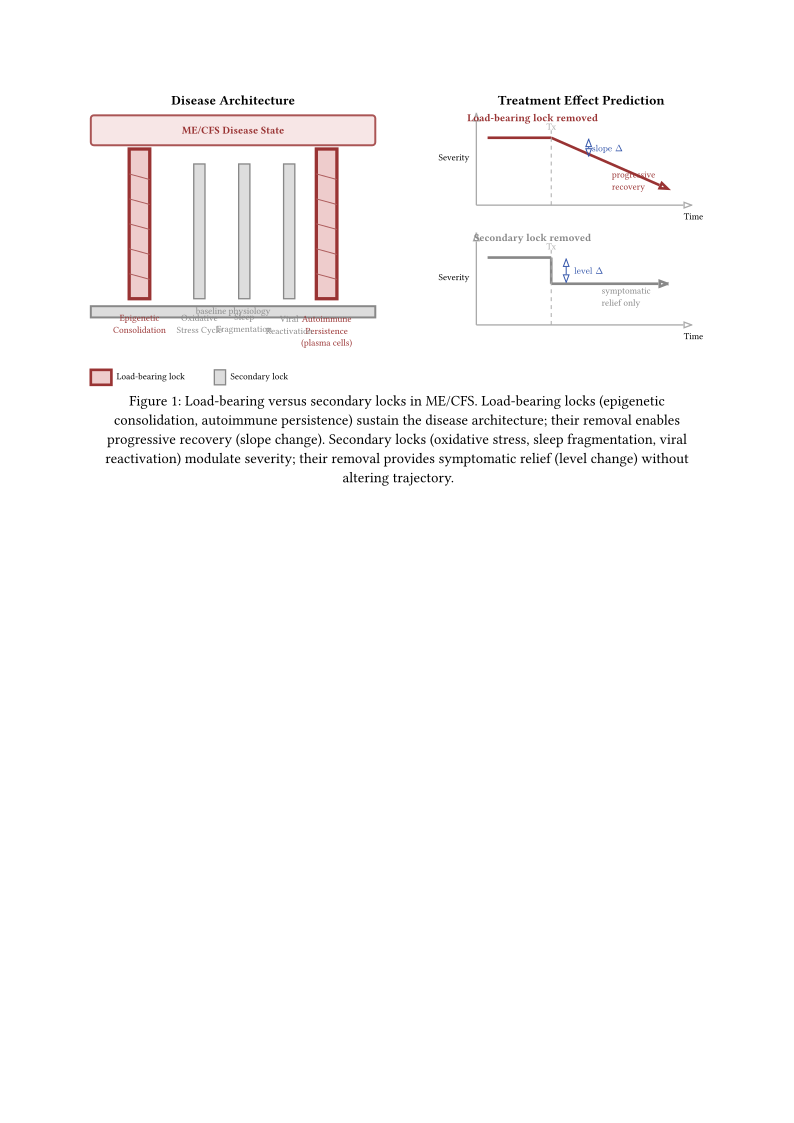
The distinction has profound therapeutic implications. Treating a secondary lock provides symptomatic benefit—often substantial, and sometimes dramatic enough that patients report feeling “much better.” But the benefit plateaus because the disease architecture remains intact. Treating a load-bearing lock may produce no immediate improvement (because other locks compensate and maintain the disease state), yet it is essential for the eventual possibility of recovery. A treatment strategy that focuses exclusively on the most symptomatic locks—the ones causing the most daily suffering—may paradoxically be less effective in the long term than one that prioritizes load-bearing locks, even if the latter produces less immediate relief.
This creates a therapeutic dilemma: do you treat what hurts now (secondary locks) or what matters for recovery (load-bearing locks)? The answer, of course, is both—but the distinction ensures that load-bearing lock treatment is not neglected because its benefits are less immediately visible.
Predicted load-bearing locks.
Epigenetic consolidation. As discussed in Section Gut Dysbiosis: Trigger-Capable in a Subgroup?, epigenetic modifications can maintain the disease gene expression program independently of the original triggers. If epigenetic consolidation has occurred, addressing the original root cause alone is insufficient: the disease state is now self-sustaining at the chromatin level. Epigenetic consolidation is load-bearing because its persistence guarantees disease persistence regardless of what else is treated. Remove the autoantibodies, disengage the safe mode, restore CNS energy—but if the epigenome still encodes the disease program, the system will re-establish the pathological state.
The load-bearing nature of epigenetic consolidation also explains the clinical observation that disease duration is the strongest predictor of prognosis. Early disease (before consolidation) is more responsive to treatment; late disease (after consolidation) resists even aggressive intervention. The “window of opportunity” for effective treatment is, in part, the window before epigenetic consolidation deepens the attractor beyond the reach of available interventions.
Autoimmune persistence. In patients with GPCR autoantibodies, the plasma cell sanctuaries that produce them represent a load-bearing lock. As long as autoantibody production continues, the downstream endothelial dysfunction, immune reprogramming, and multi-organ GPCR disruption will be maintained. This is true even if every other lock is released: the ongoing autoantibody assault will re-establish the pathological state within weeks to months.
The daratumumab response pattern is consistent with autoimmune persistence being a load-bearing lock: eliminating the plasma cell source of autoantibodies enables recovery in patients whose other locks are not yet fully consolidated (the 60% responders), while patients with deeply entrenched epigenetic consolidation may not recover even after autoantibody elimination (the 40% non-responders, who may need epigenetic intervention in addition to plasma cell depletion).
Predicted secondary locks.
Oxidative stress cycle. While oxidative stress amplifies mitochondrial damage and accelerates disease progression, it is downstream of the primary energy failure and would resolve if upstream mechanisms were corrected. Reducing oxidative stress (through antioxidant therapy) may slow deterioration and improve symptoms but cannot resolve the disease because the upstream mechanisms generating oxidative stress remain active. The oxidative stress cycle does not independently maintain the disease attractor.
Sleep fragmentation. Improving sleep quality reduces the symptom burden and may modestly improve restorative processes (glymphatic clearance, growth hormone secretion), but sleep fragmentation is generated by autonomic and neuroinflammatory dysfunction, not maintained independently. Patients whose sleep normalizes pharmacologically (e.g., with trazodone or suvorexant) without addressing upstream causes do not recover—they sleep better within the disease state.
Viral reactivation. Suppressing reactivated herpesviruses reduces immune activation and the associated metabolic burden, potentially improving symptoms. But the immune compromise that permitted reactivation persists, and other sources of immune activation remain. Antiviral therapy removes one input to the inflammatory loop, but the loop has other inputs that maintain it.
Among the amplifier mechanisms in ME/CFS, epigenetic consolidation and autoimmune persistence (plasma cell sanctuaries) are load-bearing locks whose removal is necessary for recovery. Oxidative stress, sleep fragmentation, and viral reactivation are secondary locks whose treatment provides symptomatic benefit but is neither necessary nor sufficient for recovery. The load-bearing locks are distinguished by their ability to independently sustain the disease attractor state, while secondary locks merely modulate its depth and the patient’s position within it.
Certainty: 0.40. The distinction is logically grounded in the dynamics of each mechanism and consistent with treatment response patterns (e.g., daratumumab’s 60% response rate when targeting a predicted load-bearing lock versus the modest, incomplete responses to antioxidants and antivirals targeting predicted secondary locks). However, no direct experimental test has distinguished load-bearing from secondary locks in ME/CFS, and the classification may differ across patient subgroups or disease stages.
Testable predictions:
- Interventions targeting predicted load-bearing locks (epigenetic modifiers, plasma cell depletion) should produce sustained improvement that continues to accrue over months, even when secondary locks remain, provided the root cause has been addressed or has resolved.
- Interventions targeting only secondary locks (antioxidants, antivirals, sleep aids) should produce improvement that plateaus within weeks and remains well below recovery, regardless of treatment duration or dose escalation.
- Disease duration should correlate with the number and strength of load-bearing locks (measured by epigenetic modification extent and autoantibody titer), not with secondary lock severity (oxidative stress markers, viral titers, sleep architecture disruption).
- In a multi-target treatment protocol, removing load-bearing locks should alter the trajectory of disease progression (slope change), while removing secondary locks should alter the level (intercept change).
Limitations: The load-bearing versus secondary classification may not be stable across patients or disease stages. A lock that is secondary early in disease (when the root cause is still the primary driver) may become load-bearing as the root cause resolves but the lock persists. The classification is based on theoretical reasoning about attractor dynamics rather than empirical measurement of individual lock contribution to disease maintenance.
The formal analysis of lock removal—including the minimum number and combination of locks that must be released for escape from the disease attractor—is developed in Chapter Formal Causal Hierarchy Analysis, where each lock is modeled as a parameter that modifies the attractor landscape and whose removal is analyzed for sufficiency and necessity.