Energy Metabolism Models
This chapter develops mathematical models of the energy metabolism dysfunction that lies at the heart of ME/CFS. It models ATP production, mitochondrial dysfunction, and the dynamics of healthy exercise response, then turns to the central clinical phenomenon of post-exertional malaise. The models are used to simulate the response to metabolic interventions, to analyse lactate kinetics and metabolic flexibility, and to describe mitochondrial dynamics and quality control. A consolidated cascade example ties the sections together, and a dedicated application guide explains how to use the models in practice. The chapter also extends the framework to connective-tissue and metabolic coupling.
For patients: read the Post-Exertional Malaise Modeling section to understand why exertion triggers post-exertional malaise in terms of energy reserves; it supports pacing reasoning.
For caregivers: read the Post-Exertional Malaise Modeling section for an intuition of the exertion–recovery balance that guides daily activity support.
For clinicians: read the Post-Exertional Malaise Modeling, Response to Metabolic Interventions, and Model Application Guide sections to apply metabolic reasoning and interpret intervention responses.
For researchers: read the full derivation from the ATP Production Models and Mitochondrial Dysfunction Models sections through the Mitochondrial Dynamics and Quality Control and Consolidated Cascade Example sections.
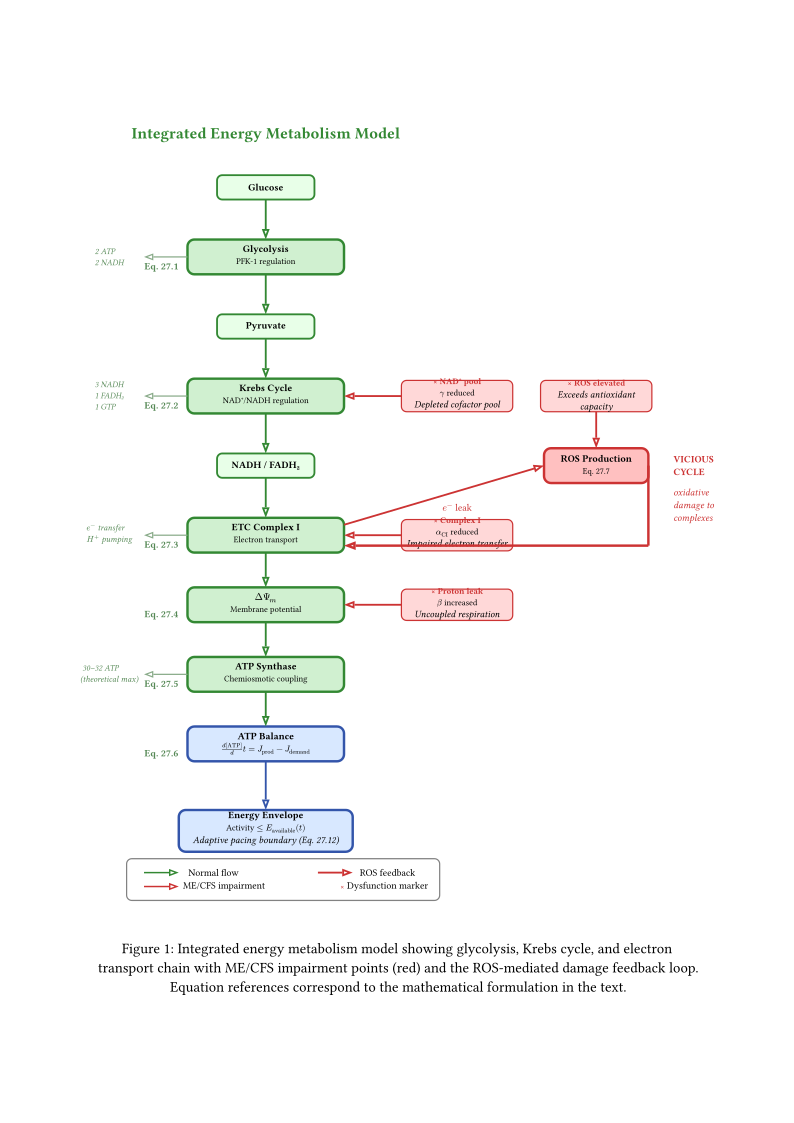 This chapter translates the qualitative understanding of energy metabolism dysfunction in ME/CFS (Energy Metabolism and Mitochondrial Function) into formal mathematical models. The models progress from individual metabolic pathways to an integrated energy production system, culminating in a quantitative framework for post-exertional malaise. All models use ordinary differential equations with Michaelis–Menten or Hill-type kinetics (Modeling Approaches); full parameter tables and derivations are in Appendix Mathematical Model Details.
1 Contents
- ATP Production Models
- Mitochondrial Dysfunction Models
- Healthy Exercise Response Dynamics
- Post-Exertional Malaise Modeling
- Response to Metabolic Interventions
- Lactate Kinetics and Metabolic Flexibility
- Mitochondrial Dynamics and Quality Control
- Model Application Guide
- Consolidated Cascade Example
- Connective Tissue and Metabolic Coupling Models