Entry Points: Multiple Doors, One Final Common Pathway
If ME/CFS has multiple trigger-capable root causes, a natural question arises: why do patients with different triggering events converge on such a similar clinical picture? A patient whose ME/CFS began after mononucleosis, another whose disease followed a car accident, and a third whose onset was associated with a period of extreme psychological stress all end up with the same cardinal symptoms—PEM, cognitive dysfunction, unrefreshing sleep, autonomic dysfunction. The triggering events share nothing obvious in common. How can such different causes produce the same disease?
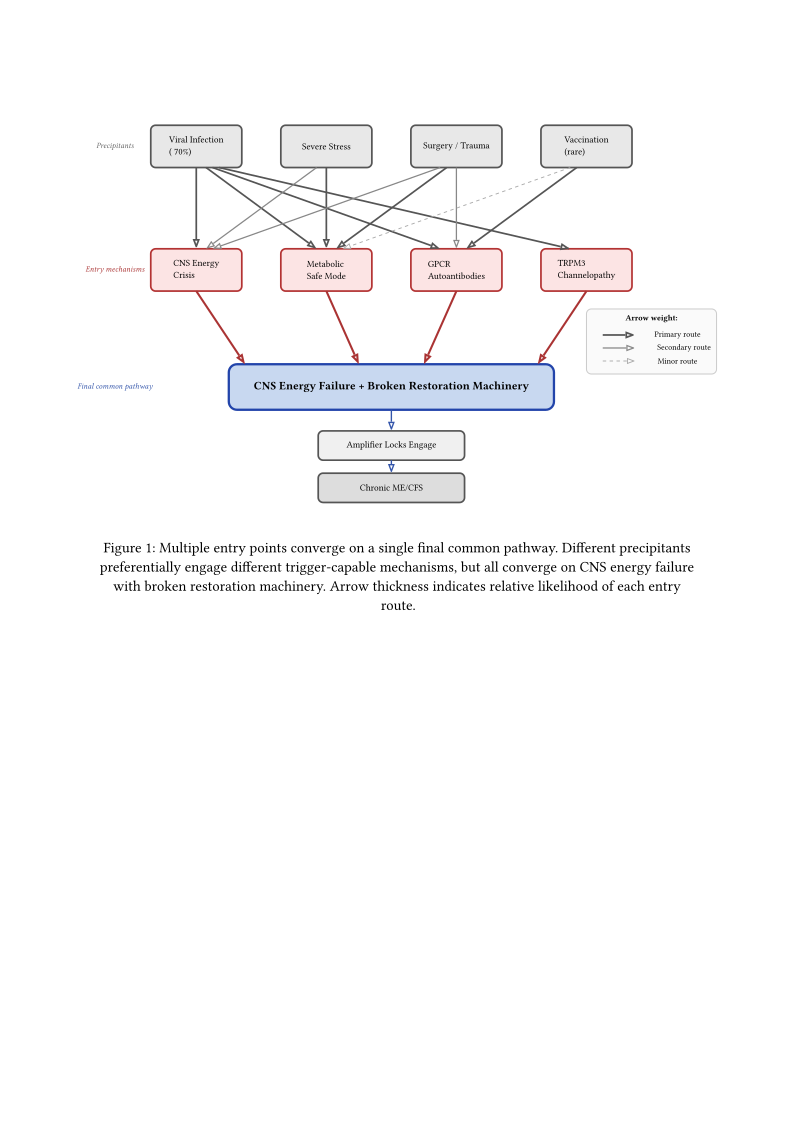
The answer, we propose, is that the trigger-capable mechanisms all converge on the same final common pathway: CNS energy failure combined with broken restoration machinery. The entry door differs; the destination is the same. This convergence is not coincidental—it reflects the architecture of human physiology, which has a limited number of “failure modes” despite having many possible inputs. Figure entry points funnel maps the routes from precipitant to entry mechanism to final common pathway.
Consider how different ME/CFS precipitants map to the trigger-capable mechanisms:
Viral infection. This is the most common ME/CFS precipitant, accounting for approximately 70% of cases, and it can enter through any of the four doors. Direct neurotropism (EBV infecting B cells that cross the BBB, HHV-6 infecting glial cells, SARS-CoV-2 infecting endothelial cells with ACE2 expression) or peripheral-to-central cytokine signaling can produce CNS energy crisis (Section Trigger-Capable Mechanisms). The innate immune response to infection activates the metabolic safe mode program through IL-6, type I interferons, and TNF-\(\alpha\) signaling to the hypothalamus (Section CNS Energy Crisis as Trigger-Capable Root Cause). Molecular mimicry between viral surface proteins and host GPCR epitopes generates autoantibodies (Section Oxidative Stress Sensing Polymorphisms as Safe Mode Predisposition). Viral modification of ion channel expression, membrane lipid composition, or post-translational modifications may produce TRPM3 dysfunction (Section GPCR Autoantibody Cascade as Trigger-Capable Root Cause).
Different viruses may preferentially trigger different root-cause pathways. EBV, with its established tropism for B cells and its LMP1-mediated mimicry of CD40 signaling, may preferentially trigger the autoimmune pathway. Enteroviruses, with their direct mitochondrial effects, may preferentially trigger the metabolic safe mode. Influenza and SARS-CoV-2, with their potent systemic inflammatory responses, may preferentially trigger CNS neuroinflammation. This pathogen-specific pathway selection may partially explain why ME/CFS following different infections can have subtly different phenotypic profiles.
Severe psychological or physiological stress. Chronic or extreme stress activates the hypothalamic-pituitary-adrenal axis and the sympathetic nervous system at levels that can exhaust catecholamine reserves, shift the hypothalamic setpoint for metabolic regulation, and produce a cortisol pattern that transitions from elevated (acute stress) to blunted (chronic stress, adrenal exhaustion). This enters primarily through the metabolic safe mode door: extreme stress triggers the protective metabolic suppression program, which then fails to disengage when the stressor resolves because the hypothalamic setpoint has shifted. Stress-induced immunosuppression may also permit herpesvirus reactivation, creating a secondary inflammatory signal that maintains safe mode engagement and may secondarily generate autoantibodies.
Surgery or trauma. The combination of tissue damage, inflammatory response, anesthesia, and physiological stress associated with major surgery can trigger multiple entry doors simultaneously. The tissue damage releases cellular contents (including mitochondrial DNA, a potent DAMP) that activate the innate immune response. The inflammatory surge may generate autoantibodies through bystander activation of autoreactive B cells that encounter self-antigens released from damaged tissue in the context of adjuvant-like inflammatory signaling. The metabolic stress of surgery activates the safe mode program. Anesthesia and perioperative hemodynamic instability may produce transient CNS energy compromise that, if the brain is predisposed (by genetic susceptibility or subclinical prior pathology), tips into sustained neuroinflammation. The simultaneous engagement of multiple root-cause pathways may explain why post-surgical ME/CFS onset is often particularly severe and treatment-resistant.
Vaccination. In rare cases, vaccination has been reported to trigger ME/CFS, plausibly through molecular mimicry generating autoantibodies against GPCRs or ion channels (the adjuvant provides the immune activation context, and the antigen provides the molecular mimicry target). The adjuvant-driven immune activation may also engage the metabolic safe mode in genetically susceptible individuals who have exaggerated innate immune responses to adjuvant signals. A distinct but related proposal attributes the effect directly to aluminium-adjuvant biopersistence (macrophagic myofasciitis) rather than to molecular mimicry — a single-site hypothesis that a nationwide registry already counts against at the population level (Section Aluminium-Adjuvant Biopersistence and Myofasciitis as a Rare Post-Vaccination Subgroup of ME/CFS, Aluminum-Adjuvant MMF: Single-Site Cohort and Registry Counter-Evidence). The population-level picture tempers the claim further: large registries find no vaccine→ME/CFS causal signal for the vaccine platforms tested (e.g. HPV HR 0.86 (Feiring et al. 2017); adjuvanted influenza HR 0.97 (Magnus et al. 2015)), and no mRNA-specific ME/CFS-endpoint registry is known to exist, while infection was the stronger precipitant in the one direct registry comparison available (HR 2.04 for pandemic influenza (Magnus et al. 2015)). The newer “post-vaccination syndrome” literature describes a ME/CFS-like phenotype whose entity status is unresolved and whose trigger is, if anything, weaker than infection (Section Aluminum-Adjuvant MMF: A Mechanistically Anchored but Population-Contested Post-Exposure Speculation). Vaccination is therefore a reportedly rare and causally untested candidate entry door — reported and trigger-compatible, but of unknown frequency and strength — with infection showing the larger reported association in the sub-syndromic comparisons (both mRNA-era; heterogeneous), no detectable vaccine→ME/CFS signal in the non-mRNA registries, and the mRNA→ME/CFS question untested.
The convergence on a final common pathway—CNS energy failure plus broken restoration machinery—explains several otherwise puzzling features of ME/CFS:
Clinical homogeneity despite diverse triggers: Once the final common pathway is engaged, the downstream manifestations are determined by the pathway itself (autonomic failure, immune dysregulation, metabolic suppression, sleep disruption), not by the entry door.
Within-disease heterogeneity: Patients who entered through different doors retain features of their specific entry mechanism. Patients with GPCR autoantibodies may have more prominent autonomic dysfunction; patients who entered through CNS neuroinflammation may have more prominent cognitive symptoms; patients who entered through the safe mode may have more prominent metabolic features (cold intolerance, metabolic inflexibility). These “entry signatures” overlay the shared core features.
Varying treatment responses: If different patients are maintained by different mechanisms (reflecting their entry pathway and which amplifiers have engaged), then no single treatment will work for everyone. Daratumumab works for the autoimmune-entry subgroup; it would not be expected to help patients whose disease entered through the safe mode pathway and is now maintained by epigenetic consolidation.
Once a patient reaches the final common pathway, the amplifier mechanisms described in Section Amplifier Mechanisms engage and lock the disease state. The entry door no longer matters because the amplifiers maintain the disease independently of the triggering mechanism. This is why the triggering event is often years in the past by the time patients seek treatment, yet the disease persists: the locks are self-sustaining.
Different ME/CFS precipitants engage different trigger-capable mechanisms, but all converge on a shared final common pathway of CNS energy failure combined with broken metabolic restoration machinery. This convergence explains the clinical homogeneity of ME/CFS despite heterogeneous triggers, while residual entry-mechanism features account for patient-to-patient variation. The convergence is not accidental but reflects the limited number of stable “failure modes” available to the human physiological system.
Certainty: 0.45. The logic is compelling and consistent with the clinical epidemiology of ME/CFS onset, the phenotypic similarity across onset types, and the variable treatment responses. However, the “final common pathway” has not been directly demonstrated at the molecular level; it is inferred from clinical similarity across onset types and from the theoretical analysis of disease attractor basins. Multi-omics studies comparing patients with different onset types would be required to confirm convergence.
Testable predictions:
- Patients stratified by onset type (post-viral, post-stress, post-surgical) should show different biomarker profiles early in disease (within the first year) but converging profiles as disease duration increases (after 3–5 years).
- Early-stage patients should respond preferentially to treatments targeting their specific entry mechanism; late-stage patients should respond more uniformly to treatments targeting the final common pathway or its locks.
- Multi-omics trajectory analysis should reveal a “funnel” topology: diverse initial states in high-dimensional omics space converging on a smaller number of attractor basins over time.
- Patients with mixed precipitants (e.g., infection during a period of extreme stress) should show more rapid progression and more severe disease, consistent with simultaneous engagement of multiple entry doors.
Limitations: The hypothesis is difficult to test without longitudinal cohorts followed from disease onset, which are expensive and logistically challenging for a disease with unpredictable onset. The concept of a “final common pathway” may be an oversimplification—there may be 2–4 distinct disease attractors rather than a single one, corresponding to different stable configurations of the multi-lock system. Additionally, if entry signatures fade quickly (within months), they may be impossible to detect in clinical cohorts where diagnosis typically occurs years after onset.
The infection cascade walkthrough in Chapter Temporal Evolution and Disease Trajectories provides a worked example of how a specific precipitant (viral infection) progresses through entry, amplification, and lock establishment to reach the final common pathway.
1 The Subthreshold Reservoir Population
The multi-entry-point model, combined with the separatrix concept from dynamical systems theory, predicts the existence of a population that has received insufficient attention: individuals sitting just below the disease separatrix. These are people with subclinical perturbations—vague fatigue, mild exercise intolerance, “not feeling right”—who do not meet ME/CFS diagnostic criteria but who are perched near the tipping point. A second hit (infection, severe stress, surgery) would push them over.
This prediction has gained urgency from the Long COVID pandemic. Su et al. demonstrated that pre-existing subclinical markers—autoantibodies, latent EBV reactivation, subclinical metabolic perturbations, and low cortisol at the time of COVID-19 infection—predicted development of post-acute sequelae (Su et al. 2022). Cervia-Hasler et al. found that persistent complement dysregulation was detectable in Long COVID patients from the acute phase, suggesting pre-existing immune vulnerability (Cervia-Hasler et al. 2024). The Dubbo Infection Outcomes Study showed that post-infectious CFS develops at approximately 11% regardless of pathogen identity, suggesting a host-response vulnerability that pre-dates the infection (Hickie et al. 2006).
These findings are consistent with a continuous distribution of “separatrix distance” in the general population, not a bimodal healthy/sick division. Most people sit far from the separatrix; their physiological reserves can absorb even substantial insults without tipping into disease. But a subset—perhaps 10–15% of the population—sit close enough that a sufficiently severe or well-targeted insult can push them across. This near-separatrix subset is recognisable in the mild and lifetime-energy presentations that populate the low end of the severity spectrum: severity clustering within ME/CFS identifies a low-severity subset functioning on a constrained daily energy envelope (Jason et al. 2010), a childhood-onset chronic-disabling-fatigue trajectory is measurable without PEM (Collin et al. 2015), and lifelong fatigue, far from excluding the diagnosis, is non-discriminating and should not be treated as a categorical exclusion (Sunnquist et al. 2015). Population data nevertheless caution that the clearest premorbid predictor of later persistent fatigue is excessive childhood energy, not low baseline energy (Harvey et al. 2009), so the near-separatrix population may be reached by overactivity as well as by constitutional low reserve.
The multi-hit model predicts a large population sitting just below the disease separatrix—individuals with subclinical perturbations across one or more disease-relevant parameters who do not meet ME/CFS criteria but are vulnerable to developing the disease after a second hit. This population is identifiable through subclinical biomarker screening and targetable for preventive intervention during acute infections or other precipitating events.
Certainty: 0.30. The prediction follows logically from the separatrix model and is supported by Long COVID risk factor data (Su et al. 2022) (Cervia-Hasler et al. 2024) and the post-infectious fatigue rate consistency across pathogen types (Hickie et al. 2006). However, the “subthreshold reservoir” population has never been prospectively identified or characterized as a group, and the separatrix distance concept has not been operationalized into measurable biomarker panels.
Testable predictions:
- Population screening would reveal a continuous distribution of “separatrix distance” (composite of subclinical immune, metabolic, and autonomic markers), not a bimodal healthy/sick division.
- Individuals in the near-separatrix region (identifiable by: mildly elevated cytokines, borderline TRPM3 function, low-normal HRV, slightly elevated autoantibody titers) have significantly higher ME/CFS incidence after acute infection compared with individuals far from the separatrix.
- Prophylactic intervention in the near-separatrix group during acute infection (aggressive anti-inflammatory support, metabolic supplementation, activity restriction) reduces ME/CFS conversion rate compared with standard care.
Limitations: Identifying the subthreshold population requires biomarker panels that do not yet exist in validated form. The “separatrix distance” is a model construct; its operationalization into measurable clinical variables requires substantial development. Prophylactic intervention trials in at-risk individuals are logistically challenging because the conversion rate (\(\\approx\) 11%) means large sample sizes are needed to detect prevention effects. The concept risks pathologizing normal variation in physiological parameters.