Temporal Evolution and Disease Trajectories
This chapter places the integrated models in time. It models disease onset, progression, and the daily and weekly dynamics of symptoms, as well as the response to exertion and other specific stimuli. It then models treatment response and long-term trajectories. Key dynamical phenomena are examined: critical slowing down and early-warning signals, hysteresis and the window for intervention, and endogenous oscillations captured by Hopf bifurcation. A model application guide explains how these temporal models are used to understand the fluctuating and often unpredictable course of ME/CFS.
For patients: read the Daily and Weekly Symptom Dynamics and Response to Specific Stimuli sections to understand why symptoms fluctuate day to day.
For caregivers: read the Daily and Weekly Symptom Dynamics section to anticipate the timing of symptom fluctuations you observe.
For clinicians: read the Disease Progression Models, Treatment Response Modeling, and Model Application Guide sections to reason about trajectories and intervention timing.
For researchers: read the full derivation from the Disease Onset Models and Long-Term Trajectories sections through the Critical Slowing Down and Early Warning Signals, Hysteresis and the Intervention Window, and Endogenous Oscillations and Hopf Bifurcation sections.
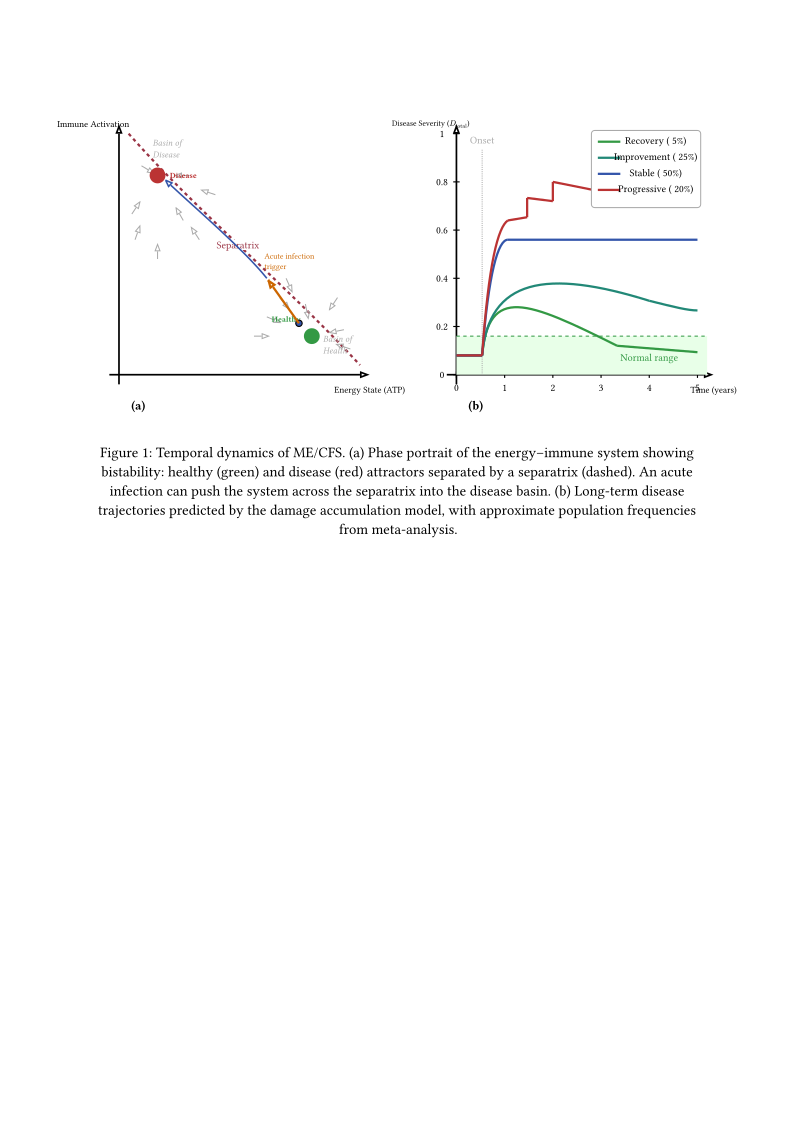 The models developed in Chapters Energy Metabolism Models through Integrated Multi-System Models describe the instantaneous dynamics of ME/CFS pathophysiology. This chapter extends the analysis to longer timescales: disease onset (days to weeks), symptom fluctuations (hours to days), disease progression (months to years), and treatment response (weeks to months). The temporal perspective reveals how the same underlying mechanisms produce qualitatively different behaviors at different timescales.
1 Contents
- Disease Onset Models
- Disease Progression Models
- Daily and Weekly Symptom Dynamics
- Response to Specific Stimuli
- Treatment Response Modeling
- Long-Term Trajectories
- Critical Slowing Down and Early Warning Signals
- Hysteresis and the Intervention Window
- Endogenous Oscillations and Hopf Bifurcation
- Model Application Guide