Treatment Implications of the Causal Hierarchy
The causal hierarchy developed in this chapter leads to a counterintuitive insight that deserves emphasis: root cause does not equal treatment priority. The most upstream, most causally fundamental mechanism is not necessarily the most important therapeutic target. Three reasons explain this disconnect, and together they define a more nuanced approach to treatment strategy.
The framework presented here is a conceptual tool for reasoning about treatment strategy, not a clinical recommendation. Individual treatment decisions require physician evaluation, patient-specific assessment, and consideration of factors far beyond causal hierarchy—including drug interactions, comorbidities, patient preferences, access, cost, and risk tolerance. All therapeutic implications discussed below are preliminary and require clinical validation before informing treatment decisions.
Reason 1: The root cause may be gone. In many patients, the triggering event—a viral infection, a period of extreme stress, a surgical procedure—resolved years ago. The virus was cleared by the immune system; the stressor ended; the surgical wound healed. The disease persists not because the root cause is still active, but because the amplifier locks it established have become self-sustaining (Section Load-Bearing versus Secondary Locks). Treating the trigger now does nothing. Antiviral therapy in a patient whose triggering virus was cleared five years ago addresses neither the root cause (which is absent) nor the locks (which are independent of the virus). The clinical implication is that the question “what caused your ME/CFS?” may be less therapeutically relevant than “what is maintaining your ME/CFS now?”
Reason 2: The most upstream cause may be least accessible. CNS energy metabolism cannot currently be directly restored with available therapeutics. We cannot inject ATP into the brain, repair neurovascular coupling pharmacologically with targeted precision, or reverse microglial activation without collateral immunosuppression. The most causally fundamental mechanism—if it is the CNS energy crisis—is also the least therapeutically accessible with current technology. Meanwhile, downstream amplifiers like mast cell activation (high tractability: antihistamines, mast cell stabilizers) or NAD+ depletion (moderate tractability: NR/NMN supplementation) are addressable now, with established safety profiles and demonstrated (if incomplete) efficacy.
Reason 3: The multi-lock model predicts that single-mechanism treatments fail. Even if a root cause is both present and accessible, treating it alone may fail because the amplifier locks maintain the disease independently. The multi-lock trap (Section Integrated Hypothesis: The Multi-Lock Trap) predicts that recovery requires releasing enough locks simultaneously that the remaining ones cannot sustain the disease state. This means treatment strategy is inherently combinatorial: the relevant question is not “which single mechanism should we target?” but “which combination of mechanisms, when addressed simultaneously, enables escape from the disease attractor?”
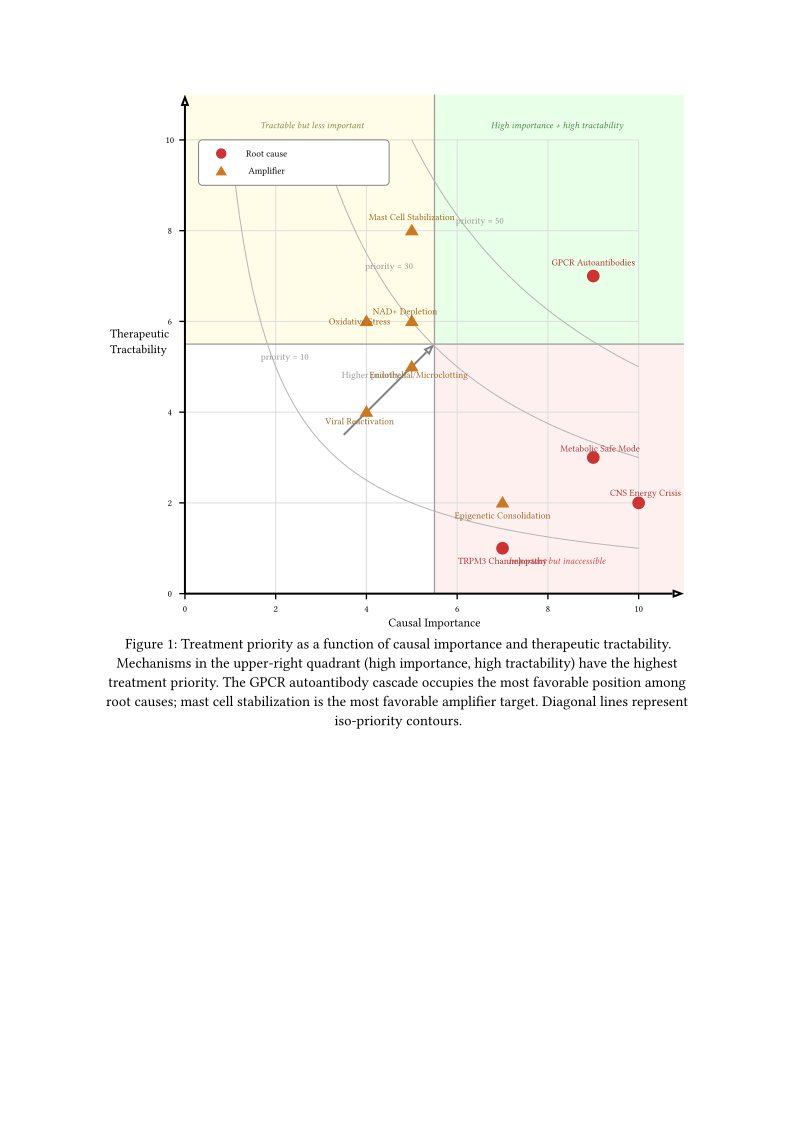
The practical conclusion is that treatment priority should be determined by the product of causal importance and therapeutic tractability, not by causal importance alone. A highly causal mechanism with zero tractability has zero treatment priority (you cannot treat what you cannot reach). A moderately causal mechanism with high tractability may have the highest treatment priority (you can treat it, and treating it contributes to the combination needed for escape). Table Treatment Priority \(\neq\) Causal Priority applies this reasoning to the mechanisms classified in this chapter.
#landscape[
| Mechanism | Causal Tier | Tractability | Priority Rank | Rationale |
|---|---|---|---|---|
| GPCR autoantibody cascade | Root cause | Moderate–High | 1 | Daratumumab and immunoadsorption demonstrate feasibility; targets a root cause that may still be active; 60% response rate is among the highest reported |
| Mast cell–energy loop | Amplifier | High | 2 | Antihistamines and mast cell stabilizers are safe, widely available, and produce rapid symptomatic relief; high tractability compensates for amplifier status; improves quality of life while other interventions take effect |
| NAD+ depletion spiral | Amplifier | Moderate | 3 | NR/NMN supplementation is commercially available and well-tolerated; addresses a key amplifier of energy failure; benefits accrue over 8–12 weeks |
| Epigenetic consolidation | Amplifier (load-bearing) | Low | 4 | Critically important for recovery but current tools are limited; early intervention to prevent consolidation is far more feasible than reversal of established consolidation; argues for aggressive early treatment |
| Metabolic safe mode lock | Root cause | Low–Moderate | 5 | No specific intervention exists to “reset” the hypothalamic setpoint; indirect approaches (controlled immune challenge, metabolic reprogramming protocols) are experimental and poorly characterized |
| Endothelial activation / microclotting | Amplifier | Moderate | 6 | Anticoagulants and endothelial support are available; benefit depends on upstream immune activation being concurrently addressed; may enable other treatments to reach target tissues |
| CNS energy crisis | Root cause | Low | 7 | Most causally important but least therapeutically accessible; transcranial photobiomodulation, intranasal insulin, and hyperbaric oxygen are experimental with limited ME/CFS-specific data |
| TRPM3 channelopathy | Root cause | Low | 8 | No approved TRPM3-targeted therapies exist; channel modulation by existing compounds (pregnenolone sulfate) is a research tool, not a therapeutic; pharmaceutical TRPM3 modulators are in early development |
| Viral reactivation \(\leftrightarrow\) immune exhaustion | Amplifier | Low–Moderate | 9 | Antivirals address only one component of a bidirectional loop; benefit inconsistent across trials; most appropriate as adjunct to immune-targeting therapies |
| Oxidative stress vicious cycle | Amplifier (secondary) | Moderate | 10 | Antioxidants are widely available but address a secondary lock; benefit is real but modest and supportive; most useful as part of a combination protocol |
:::
The ranking discussed below explains several patterns in the ME/CFS treatment literature. GPCR-targeted immunotherapy ranks highest because it addresses a root cause with demonstrated tractability; the 60% daratumumab response rate is among the highest reported for any ME/CFS intervention, suggesting that in the autoantibody-positive subgroup, the autoimmune mechanism is both active and accessible. Mast cell stabilization ranks second despite being “merely” an amplifier because its high tractability and rapid onset make it an efficient first-line intervention that improves quality of life immediately while slower, more causally fundamental treatments take effect. By contrast, the CNS energy crisis—arguably the most causally important mechanism—ranks seventh because no current therapeutic approach can directly and selectively address it. See Table Treatment Priority \(\neq\) Causal Priority.
The ranking also suggests a treatment sequencing strategy: begin with high-tractability interventions (mast cell stabilization, NAD+ supplementation) that provide immediate symptomatic relief, add root-cause-targeting interventions (immunoadsorption or daratumumab in autoantibody-positive patients) as they become available, and incorporate experimental approaches targeting low-tractability mechanisms (CNS energy restoration, epigenetic modification) as the field advances.
Figure treatment priority scatter visualizes the relationship between causal importance and therapeutic tractability for all classified mechanisms. The GPCR autoantibody cascade occupies the most favorable position among root causes (high importance, moderate–high tractability), while the CNS energy crisis—despite being the most causally fundamental—falls in the “important but inaccessible” quadrant. This visual representation makes concrete the chapter’s central therapeutic insight: root cause does not equal treatment priority.
The treatment optimization framework in Chapter Predictive Applications and Clinical Translation builds on this hierarchy to model combinatorial treatment strategies, predicting which combinations of interventions are most likely to release enough locks for disease escape.
1 The Patient-Accessible Epigenetic Reversal Strategy
For patients with established disease where epigenetic consolidation is a load-bearing lock, the formal analysis in Chapter Formal Causal Hierarchy Analysis (Per-Locus Dynamics: Vector Model for Bidirectional Methylation, Section Lock Removal Sequence Dependence) predicts that the optimal treatment order depends on whether the patient is gain-dominant, loss-dominant, or mixed. For gain-dominant patients, energy restoration must precede or accompany epigenetic intervention. For loss-dominant patients, remethylation at ProB repeats may precede energy restoration. For the most typical mixed patients, methyl-donor support (SAMe, methyl-folate, methyl-B12, betaine) combined with energy restoration provides the safest default. This section describes the gain-dominant scenario (passive demethylation); for the complementary loss-dominant scenario (active remethylation), see Speculation Consolidation as Loss of Methylation and the full mathematical treatment at Per-Locus Dynamics: Vector Model for Bidirectional Methylation. The practical long-duration strategy below avoids toxic epigenetic drugs (5-azacitidine, HDAC inhibitors) in favor of sustained anti-inflammatory and metabolic support to permit passive epigenetic reversal at hypermethylated loci.
The logic for gain-dominant patients: hypermethylation at ProA/gene-region loci is driven upward by DNMT3A/3B activity, which responds to inflammatory and metabolic stress signals (\(C_\text{pro}\), oxidative stress). Sustained reduction of these signals—through 18–24 months of anti-inflammatory therapy plus metabolic support—would reduce the driving force for methylation, allowing the natural process of passive demethylation (TET-mediated oxidation followed by replication-coupled dilution (Bolton, Bhatt, et al. 2019)) to gradually erode \(\mathcal{M}\) at gain-dominant loci without pharmacological intervention at the epigenetic level. For loss-dominant patients (ProB repeat hypomethylation), this passive-reversal logic does not apply: remethylation at hypomethylated loci requires active DNMT3B activity and adequate SAM pools, not merely the withdrawal of eroding signals.
The following is a speculative hypothesis about a therapeutic strategy, not a clinical recommendation. It has not been tested in clinical trials, has no safety data specific to ME/CFS, and must not be implemented without physician guidance. The duration (18–24 months) and multi-component nature of the proposed approach carry risks that have not been characterized.
For patients with gain-dominant epigenetic consolidation: sustained (18–24 month) anti-inflammatory therapy to reduce signals driving DNMT activity (\(C_\text{pro}\)), combined with metabolic support (CoQ10, NR/NMN, d-ribose) to improve \(\alpha_\text{CI}\), would allow passive demethylation (\(k_\text{demeth}\)) to gradually erode \(\mathcal{M}\) at hypermethylated loci without requiring toxic epigenetic drugs. For loss-dominant patients (ProB repeat hypomethylation), passive demethylation is not the mechanism — active remethylation via methyl-donor support (SAMe, methyl-folate, methyl-B12, betaine) is required (see Speculation Consolidation as Loss of Methylation and Per-Locus Dynamics: Vector Model for Bidirectional Methylation for the unified treatment across both directions).
Certainty: 0.30 for the gain-dominant scenario (logic follows from ODE dynamics; individual components have independent evidence). 0.20 for the loss-dominant scenario (remethylation as therapeutic strategy is entirely untested in ME/CFS; efficacy unproven).
Key parameters:
- Duration: 18–24 months minimum (matches \(\tau_\text{epi}\) from The Disease State ODE System in Chapter Formal Causal Hierarchy Analysis)
- Anti-inflammatory: LDN, low-dose corticosteroid, or targeted cytokine blockade
- Metabolic support: CoQ10 + NR/NMN + d-ribose (targeting \(\alpha_\text{CI}\))
- Monitoring: serial methylation profiling every 6 months to track \(\mathcal{M}\) trajectory
Testable prediction (gain-dominant): Patients on sustained (>18 month) anti-inflammatory + metabolic support should show measurable reduction in disease-associated CpG methylation at hypermethylated immune cell loci, compared with matched patients on metabolic support alone (without anti-inflammatory component). The anti-inflammatory component is critical because it reduces the signal driving re-methylation. Testable prediction (loss-dominant): Patients on sustained (>18 month) methyl-donor support (SAMe + methyl-folate + methyl-B12 + betaine) should show measurable remethylation at ProB repeats (pericentromeric satellites, young LINE-1s), with corresponding reduction in HSAT2 expression and immune exhaustion markers, compared with matched patients on standard care.
Limitations: The 18–24 month duration makes clinical trials expensive and difficult to control. Compliance over this period is challenging. The passive demethylation rate in lymphocyte subsets has not been precisely measured in ME/CFS patients. The strategy may be insufficient for patients with deep consolidation at loci below \(m_i^\text{crit}\) (irreversibility threshold, Per-Locus Dynamics: Vector Model for Bidirectional Methylation), where even complete removal of driving signals may not produce enough passive demethylation to cross the recovery threshold, and for ProB loss-dominant patients where active remethylation alone may be insufficient without concurrent energy restoration.